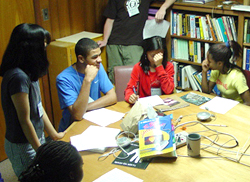
 Interns mentor workshop students at Shodor's Broad Street office (2003)
Since its incorporation in 1994, Shodor has come a long way, pursuing the mission of improving math and science education through computational science. At the core of Shodor's dramatic growth and effectiveness is its authentic use of computers in transforming science and mathematics education through the internet and network technologies.
From the beginning, when many other education-focused organizations were utilizing CD's to capture and share their resources, Shodor recognized the power of the internet and networking, and developed those components of its activities through tools like Interactivate.
In the beginning, with just three computational science tools to its name, Shodor was able to easily demonstrate the engaging world of computational science. Through real-time manipulation of data representations on a computer screen and showing how the end results take shape "right before your eyes," the message was clear. Educators marveled at the instructional opportunities and students began to learn math and science concepts in a much more realistic and meaningful way.
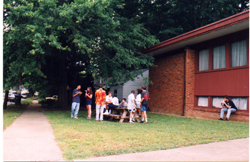 SUCCEED Workshop students outside Shodor's Broad Street office (2002)
As internet and networking technologies advanced and as connectivity became faster and more powerful, Shodor responded with more effective tools and saw continued growth in its audience of educators and students.
Today, Shodor's bank of computational science education tools has grown to a substantial level. They are widely utilized on national and international levels. Today, the Shodor websites garner 3-million to 3.5-million page views per month. Tools such as Interactivate and the Computational Science Education Reference Desk (CSERD) are not only website award-winners, but they are widely popular among students and educators alike and help to improve math and science education. Usage and linkage has been so extensive that a “Google” search for nearly any term in math or science (try, for instance: acid base, stoichiometry, pie chart, histogram, bar graph, stopwatch, arithmetic quiz, among others) will return Shodor resources at or near the top of the list.
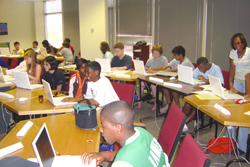 A workshop at Shodor's former office in the Durham Centre (2007)
Shodor has grown to a staff of 16 scientists and educators, and proudly involves more than 30 interns and a dozen apprentices in many aspects of our internet and network design, creation and maintenance -- a unique and meaningful “real world” hands-on learning project for all of the students. Dozens of college faculty who are graduates of the National Computational Science Institute (NCSI) workshops are active collaborators, and more than 1,000 NCSI alumni participate in the review process of the Computational Science Education Reference Desk (CSERD) .